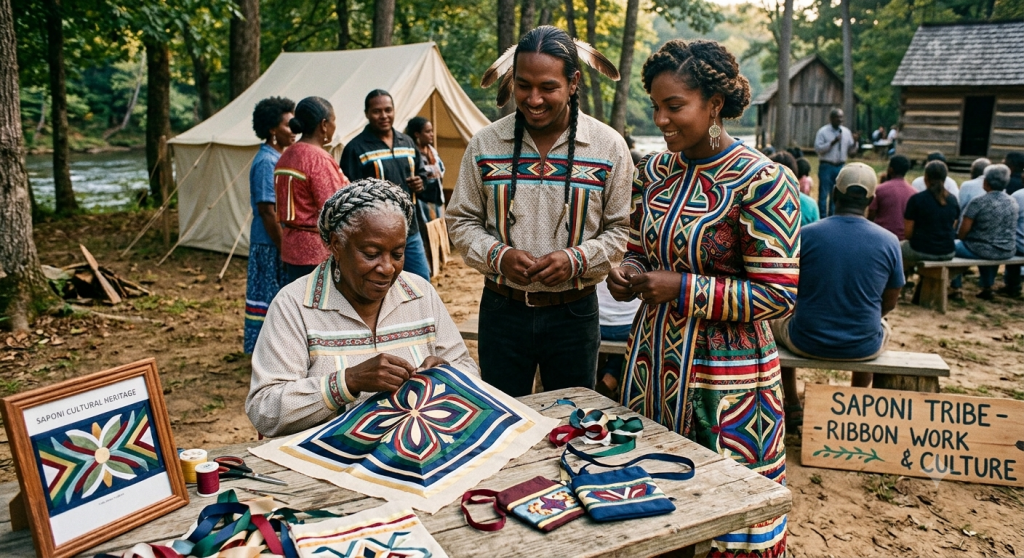
When European traders introduced silk and satin ribbons at colonial trading posts like Fort Christanna in the early 18th century, Saponi and regional Eastern Woodlands artists did not merely adopt European styles. Instead, they completely re-engineered this luxury textile through an Indigenous lens, creating an intricate artistic tradition known as ribbonwork appliqué.
Far from being a simple fashion trend, ribbonwork became a deeply meaningful method of cultural expression and storytelling.
A Evolution of Ancient Geometry
Before the arrival of trade goods, Eastern Woodlands tribes used painted mineral pigments, porcupine quills, and dyed moose hair to create border designs on buckskin clothing. Ribbons did not replace these ancestral designs—they translated them into a new medium.
- Sacred Geometry: The diamond chains, fluid waves, triangles, and stepped patterns cut into ribbons represented cosmological concepts, tribal lineages, and the local Piedmont landscape.
- Color Language: Colors carried profound spiritual meanings. Deep blues and blacks often represented the earth or underworld, while bright reds and whites symbolized life, vitality, or peace. The combination of colors allowed the wearer to silently communicate their status and identity.
The Ultimate Status Symbol
From a purely stylistic standpoint, ribbons were the high fashion of the 18th-century fur trade. Because silk had to be imported overseas, it was highly valuable.
- Wealth and Prestige: Layering multiple rows of ribbons onto a breechcloth or the side flaps of leggings was a direct display of a family’s wealth, high social standing, and trading prowess.
- Aesthetics of Movement: Silk ribbons added a dynamic, fluid element to clothing. During ceremonies or dances, the sheen of the fabric caught the light, and the long, trailing ends fluttered with the wind, creating a beautiful visual spectacle.
The Appliqué Technique
To create these garments, Indigenous women invented a highly complex positive-and-negative space layering technique:
- An artist would choose two or more ribbons of contrasting, vibrant colors (such as deep indigo and bright scarlet).
- She would cut precise slits, peaks, or geometric shapes into the top ribbon, then fold the raw edges under to create perfectly crisp lines.
- She would layer this cut ribbon over the solid base ribbon and attach it to a heavy wool fabric like Stroud cloth.
- Using tiny, nearly invisible hand stitches with fine silk thread, she secured the layers, resulting in a stunning, multi-layered mosaic pattern.
Through ribbonwork, the Saponi took the raw materials of global commerce and transformed them into an enduring symbol of Native artistry and survival.


