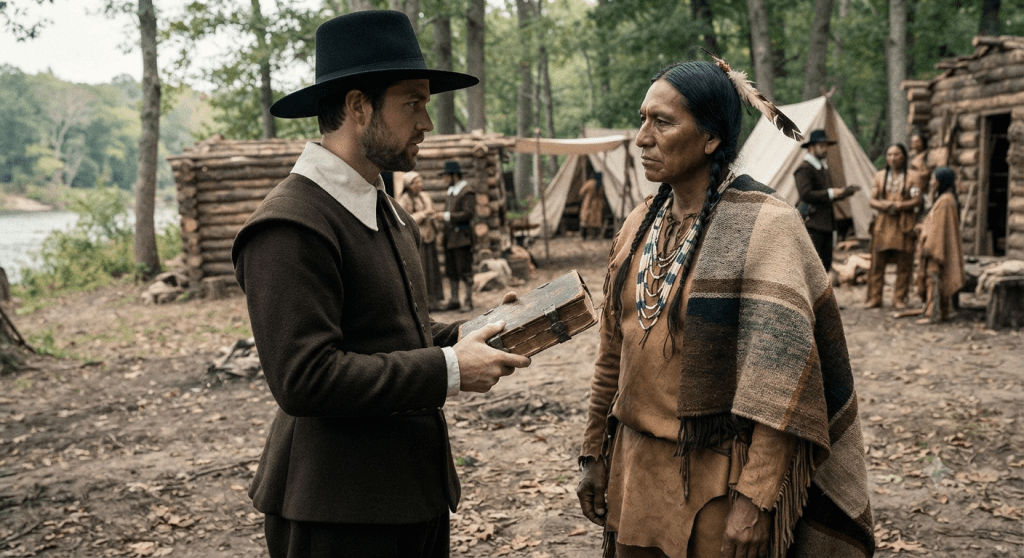
For centuries, standard history textbooks taught a narrow, linear narrative of human civilization. We were told that complex society, advanced engineering, and deep spiritual law began exclusively in the Middle East and Western Europe. Indigenous Americans were frequently pushed to the margins—depicted as people without history, without permanence, and without a structured relationship to the Creator until European ships arrived on their shores.
Modern archaeology, linguistics, and Indigenous scholarship are completely upending that Eurocentric worldview.
By looking closely at the breathtaking timelines of North America’s ancient earthworks, we can dismantle colonial myths, understand the profound weight of what was stolen, and see how modern Indigenous communities are reclaiming their spiritual and historical narratives.
The Silent Witnesses: Earthen Engineering That Predates the Bible
To understand the depth of Indigenous history, we must look at the dirt beneath our feet. For generations, the monumental stone pyramids of Egypt stood as the universal benchmark for ancient human engineering. Yet, hidden in plain sight across the American continent are earthen structures that make the pyramids look young.
The LSU Campus Mounds in Baton Rouge, Louisiana, are officially recognized as the oldest surviving human-made structures on Earth. Comprehensive geological testing and radiocarbon dating confirm that construction on these mounds began approximately 11,300 years ago [lsu.edu]. GLOBAL HISTORICAL TIMELINE │ ├─ c. 9300 BCE: LSU Campus Mounds Construction Begins (America) │ ├─ c. 3500 BCE: Watson Brake Multi-Mound Complex Completed (America) │ ├─ c. 2670 BCE: Step Pyramid of Djoser Built (Egypt) │ ├─ c. 1200 BCE: Earliest Texts of the Hebrew Bible Written (Middle East) │ ├─ c. 1000 BCE: Olmec Civilization Builds La Venta Pyramid (Mesoamerica) │
To put this immense timeline into perspective:
- The American Mounds (c. 9300 BCE): Were built at the end of the last Ice Age, around the same era as Göbekli Tepe in Turkey.
- The Great Pyramid of Giza (c. 2560 BCE): Was built roughly 6,700 years after the LSU mounds.
- The Holy Bible (c. 1200 BCE): Scribes began writing the earliest texts of the Hebrew Bible nearly 8,000 years after Indigenous Americans began engineering their sacred landscapes.
These mounds were not random piles of debris. They were masterworks of soil mechanics. Indigenous engineers meticulously layered different clays and organic soils to prevent erosion, creating structures that have survived millennia of intense Mississippi Valley floods. Furthermore, these sites were giant, living calendars—precisely aligned with solar solstices, lunar cycles, and constellations to bring cosmic law down to earth.
The Double Dispossession: The Theft of Land and Religion
When European colonizers arrived in the 15th through 18th centuries, they encountered advanced, deeply spiritual societies like the Saponi of the Virginia-Carolina Piedmont. In 1728, a Saponi guide named Ned Bearskin shared the “Three Great Articles of Natural Religion” with colonial surveyors, outlining a sophisticated moral code rooted in a Supreme Creator (Monack), a clear distinction between good and bad deeds (such as condemning domestic abuse and dishonesty), and a system of afterlife justice.
Because traditional Indigenous law viewed the land as a sentient relative to be protected—rather than a piece of property to be bought, sold, and fenced—colonizers weaponized Western theology to steal it.
Through the Doctrine of Discovery, European powers declared that any land inhabited by non-Christians was legally “empty” (terra nullius). To take the land, they had to systematically erase the religion. This double dispossession was carried out with brutal efficiency:
- Physical Displacement: Forcing tribes off their ancestral territories legally severed them from the sacred mountains, rivers, and mounds required to perform their ceremonies.
- The Criminalization of Faith: In 1883, the U.S. government enacted the Code of Indian Offenses, making traditional feasts, dances, and medicine practices criminal acts punishable by imprisonment or the withholding of food rations.
- The Boarding School System: Generations of Native children were forcibly removed from their families and placed in institutional boarding schools. Under the administrative philosophy “Kill the Indian, Save the Man,” children were physically punished for speaking their languages or practicing their traditional faith, replaced by mandatory Western Christian instruction.
Reclaiming the Narrative: Indigenous Biblical Hermeneutics
Despite centuries of systematic land theft and religious erasure, Indigenous identity was never destroyed. Today, many Native descendants practice mainstream Christian faiths (such as the modern Saponi communities in the Baptist and Methodist traditions), but they are doing so on their own terms.
During the Self-Determination and Red Power Eras of the 1970s and 1980s, a powerful intellectual movement emerged: Indigenous Biblical Hermeneutics[library.law.howard.edu, en.wikipedia.org].
This was not done to appease European colonists or modern Western churches. It was developed as an act of theological sovereignty to challenge colonial narratives. Indigenous Christian scholars separate the spiritual teachings of Jesus—a brown-skinned, tribal Middle Eastern man living under the brutal military occupation of the Roman Empire—from the white, imperialist systems that used his name to justify colonization.
These scholars argue that the Creator was actively walking with Indigenous Americans for tens of thousands of years before European contact. They view their deep history, their ancient moral laws, and their monumental earthworks as proof of a “First Revelation”—a sacred covenant between their ancestors and the earth that predates the written pages of the Bible itself.
History Cannot Be Erased
When we look at the oldest mounds in America, we are looking at monuments of endurance. They stand as physical proof that Indigenous history is deeper, older, and far more sophisticated than colonial narratives ever dared to admit.
By recognizing that America holds the oldest mounds on earth, we do not just correct a line in an archaeology textbook; we honor the ancient, unbroken stewardship of the first people of this continent, whose laws, morality, and connection to the cosmos remain written permanently into the soil.

