This guide serves as a digital reference of our traditional family protocols, matrilineal governance, and the customary laws that protect the peace and integrity of the Saponi household.
1. Core Structure: Matrilineal Governance
Lineage and Identity: Clan identity, names, and tribal belonging pass strictly through the mother’s line.
The Household Domain: Longhouses and family dwellings belong to the women of the clan; a husband resides in his wife’s family domain as a guest.
Children’s Standing: Children belong entirely to the mother’s clan, ensuring their protection, inheritance, and identity remain intact regardless of marital changes.
2. Roles within the Clan Leadership
The Matriarchs (Elders): The senior women of the clan hold final authority over household operations, marriage approval, and internal resource management.
The Maternal Uncle: The mother’s brother serves as the primary male authority figure, protector, and disciplinarian for his sister’s children.
Cousin Kinship: First cousins through the maternal line (parallel cousins) are viewed legally and socially as brothers and sisters, strengthening the core family unit.
3. Protocol for Marital Conflict with a Foreigner
When an outsider or foreigner marries into the clan and causes persistent disruption, disrespect, or abuse, the family activates the following traditional protocols:
Step 1: Elder Evaluation
Review: The family matriarchs and elders meet privately to assess the outsider’s behavior against community standards of respect and balance.
Mediation: If appropriate, initial boundaries are communicated clearly to the outsider, detailing the required behavioral corrections.
Step 2: Maternal Uncle Intervention
Confrontation: If the problematic behavior or abuse continues, the maternal uncle steps in directly as the defender of the household.
Expulsion: Utilizing his traditional authority, the maternal uncle can permanently eject the problematic foreign spouse from the clan’s home and property.
Step 4: Social Shunning and Isolation
Severing Ties: If the outsider refuses to respect the expulsion, the clan and the broader community enforce strict social shunning.
Total Invisibility: Community members completely withdraw communication, trading, and social recognition from the individual.
Space Protection: The outsider is strictly barred from entering tribal grounds, ceremonies, and private family gatherings.
4. Preservation of Peace
In Saponi governance, the harmony and spiritual safety of the matrilineal collective always supersede an individual marriage. If a marriage brings chaos instead of balance, the clan moves decisively to restore peace, protect the children, and secure the household boundaries.
Long before European contact, the Saponi and neighboring Piedmont Siouan-speaking tribes maintained a sophisticated, deeply moral spiritual system. Grounded in a profound relationship with the landscape of the Piedmont region (across modern-day Virginia and North Carolina), Saponi spirituality connected daily survival, clan governance, and the afterlife into a seamless whole.
Here is a comprehensive guide to the traditional theology, rituals, and worldviews of the Saponi people.
1. The Supreme Creator: Mohoni
At the apex of Saponi cosmology sat Mohoni (historically recorded as Mohomny), the Supreme Creator and Sustainer of life. Unlike the distant or vengeful gods of some global traditions, Mohoni was understood by the Saponi as an entirely positive, benevolent, and perfectly just force.
Master of the Universe: Mohoni created all things—the sun, moon, stars, earth, water, plants, and animals.
The Multi-Verse Theory: Traditional Saponi theology taught that this current world was not the first. Mohoni had created and dissolved multiple worldsacross vast stretches of time before establishing the present one.
Intermediary Spirits: While Mohoni was the ultimate authority, the cosmos was also filled with lesser deities and helper-spirits. These spirits inhabited natural elements and acted as intermediaries, executing the Creator’s will on Earth.
2. Moral Accountability and the Forked Path
The Saponi held a firm belief in individual and collective moral responsibility, closely tied to a detailed concept of the afterlife. Mohoni was believed to actively monitor human behavior, rewarding righteousness and punishing malice.
The Standard of Morality
To the Saponi, living a good life meant upholding the community. Virtuous actions included:
Defending the clan and honoring the elders.
Feeding the hungry and sharing resources generously.
Telling the absolute truth and keeping one’s word.
Conversely, lying, cheating, stealing, and murder were considered severe offenses against the natural and spiritual order.
The Forked Path of the Soul
Upon death, the human soul traveled down a long spiritual road until it reached a critical fork in the path, guarded by an elder spirit. Here, the soul’s earthly deeds determined its eternal destination:
The Warm Country (The Righteous): Good souls were directed down the path to a paradise characterized by perpetual warmth, abundant food, crystal-clear springs, and endless hunting grounds. In this realm, youth was restored, and sickness did not exist.
The Cold Country (The Wicked): Wicked souls were sent down a dark, treacherous path leading to a barren, freezing wasteland. Here, the soil produced nothing, hunger was constant, and souls were continually tormented by fearsome creatures.
The Cycle of Reincarnation: Crucially, the Saponi did not view these destinations as permanent traps. Their cosmology embraced a strong concept of reincarnation, believing that after a period of purging or reward, souls would eventually be reborn back into the earthly world to try again.
3. Sacred Earth: Materials and Ritual Practices
The natural world was the primary altar for Saponi worship. Specific elements of the Piedmont landscape carried immense spiritual weight and were used to communicate with Mohoni and the helper-spirits.
White Quartz Stones
The Crystal of Truth: High-quality white quartz is native to the Piedmont region. For the Saponi, these stones were intensely sacred, representing clarity, spiritual purity, and truth.
Ritual Use: Quartz crystals were utilized by medicine people and elders in rituals to focus intentions, seek visions, and maintain absolute honesty during critical tribal councils.
Red Willow Tree (Ozier)
The Sacred Bark: The inner bark of the red willow was highly valued for both its physical medicinal properties (containing salicin, a natural pain reliever) and its spiritual utility.
The Smoke of Prayer: When dried and prepared, red willow bark was frequently blended with traditional tobacco for ceremonial smoking. The rising smoke carried the prayers of the people directly upward to Mohoni.
4. Clan Governance: Handling Mental Instability and Crisis
In traditional Saponi society, spiritual health and mental health were deeply intertwined. The community operated under a matrilineal clan structure, where family lineage and tribal identity were passed down through the mother.
When a Saponi parent or community member exhibited severe mental instability or what modern psychology might classify as a “bipolar spiral,” the clan handled the crisis collectively, prioritizing balance, safety, and rehabilitation over punishment:
Matriarchal Intervention: Clan mothers and grandmothers held the ultimate authority. They would step in immediately to protect any children involved, temporarily or permanently placing them with maternal aunts or elders to ensure stability.
Medicine People and Spiritual Cleansing: Elders and spiritual leaders viewed severe mood shifts or irrational behavior as a spiritual imbalance or a disruption of the person’s connection to the community. They would use herbal tinctures, sweat lodges, and specific cleansing ceremonies to help restore the individual’s mind.
Collective Accountability: Because the tribe operated as an extended family, an unstable individual was never left isolated. The community shared the burden of care, working to ground the person back into the daily rhythms of tribal life once the crisis passed
Ancestors of the Meadows: The Resilience of the Saponi People
The story of the Saponi Tribe and their modern descendants, the Haliwa-Saponi of Warren and Halifax counties, North Carolina, is a powerful testament to indigenous survival. Despite centuries of colonial expansion, land theft, and bureaucratic erasure, the core families of this Piedmont nation successfully protected their identity, culture, and sovereignty.
Here is a look at the history, traditions, and enduring spirit of the Saponi people.
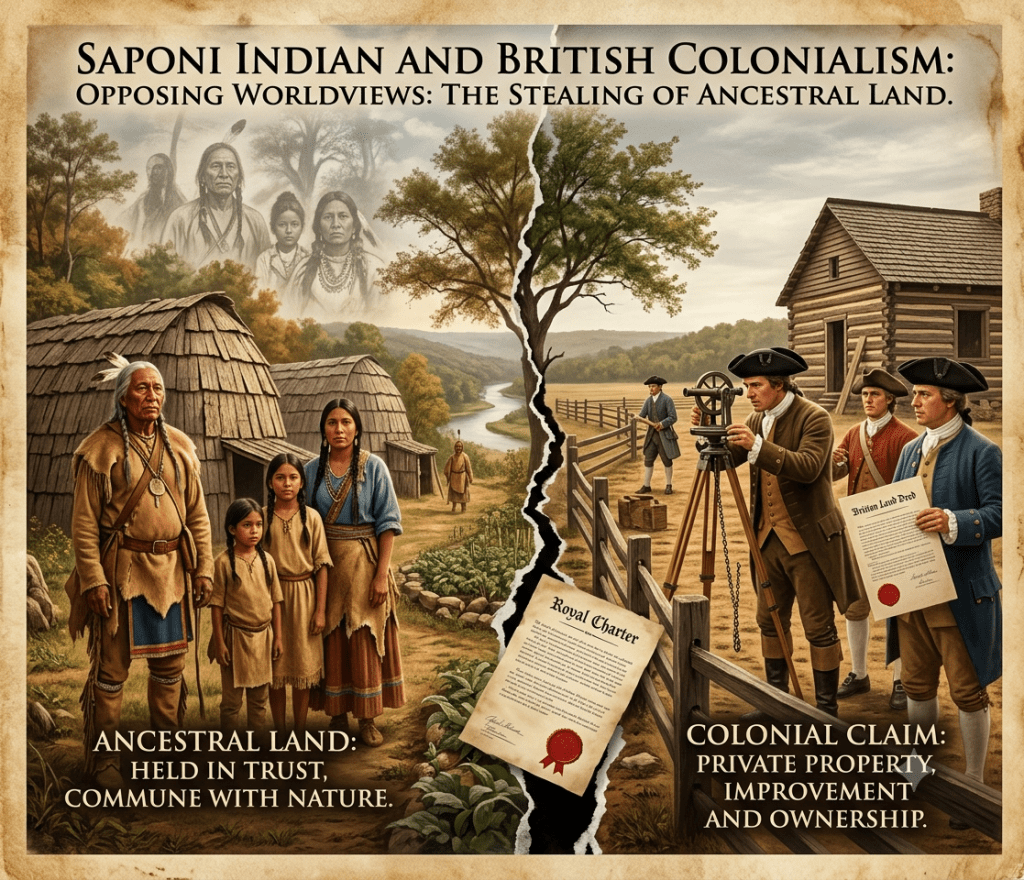
1. Opposing Worldviews: The Stealing of Ancestral Land
The conflict between the Saponi and European immigrants stems from two completely incompatible definitions of the earth:
The Saponi Worldview: The land was viewed as a living, sacred relative. The tribe practiced communal custodianship rather than private ownership, rotating crops and leaving large forest tracts intact to maintain natural harmony.
The Immigrant Takeover: Guided by the international legal framework of the Doctrine of Discovery, European colonists viewed any land not occupied by Christians as legally vacant (terra nullius). Driven by an economic system where wealth was measured in private property, immigrants aggressively fenced off territories, cleared the forests for timber, and claimed exclusive rights to the soil through written deeds.
2. Geographic Refuge and “Paper Genocide”
Faced with total displacement from their traditional Piedmont villages, Saponi families retreated into the isolated, swampy lowlands of Warren and Halifax counties—an area known historically as “The Meadows.”
Hiding in Plain Sight: In this rugged terrain, core ancestral families like the Hedgepeths, Richardsons, Lynches, and Evanses formed a close-knit, self-protective enclave. During the colonial era, they actively sheltered and integrated escaped African slaves and white indentured servants rather than adopting chattel slavery.
Bureaucratic Erasure: Throughout the 1800s, the state of North Carolina enforced a strict racial binary. On official census records, courthouse officials stripped away the classification of “Indian” from landless Saponi descendants, legally reclassifying them as “Free Persons of Color” or “Mulatto” to systematically erase their native birthright and land claims on paper.
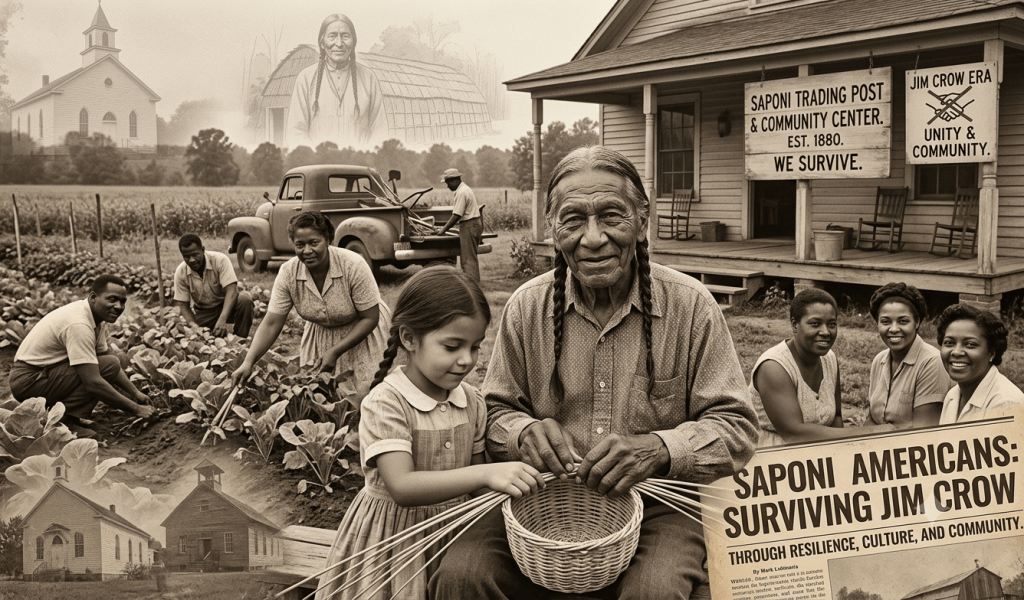
3. Surviving the Jim Crow Era
During the late 19th and mid-20th centuries, the systemic taking of land and identity reached a legal peak through tri-racial segregation:
Educational and Legal Barriers: Local school boards built facilities only for white and Black children, barring Saponi children from white schools while families refused to send them to Black schools to prevent the legal erasure of their heritage. Furthermore, corrupt land speculators used high property tax traps and predatory contracts to seize valuable family farms from illiterate elders.
The Fight for Sovereignty: To survive, the community pooled their resources to build independent institutions. In 1948, they established Mt. Bethel Indian Baptist Church as their political and spiritual headquarters. In 1957, utilizing their own labor and lumber, they built the Haliwa Indian School in Hollister. These actions legally proved their continuous tribal existence, breaking the back of Jim Crow locally and securing North Carolina State Recognition on April 15, 1965.
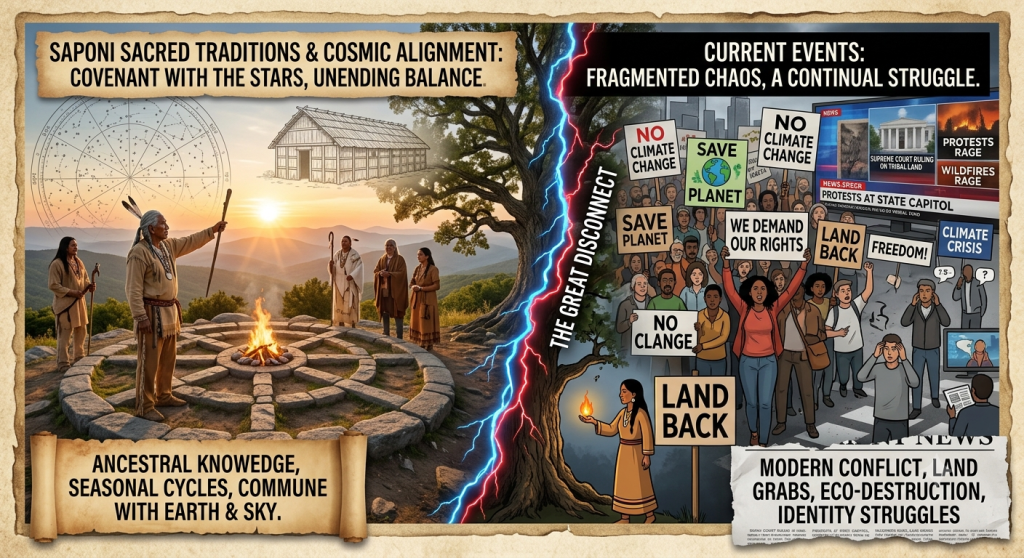
4. Sacred Traditions and Cosmic Alignment
Throughout these centuries of displacement, the Saponi kept their core spiritual cosmology alive in private:
The Rhythm of the Moon: The Saponi used lunar cycles as a precise environmental guide, naming moons after seasonal shifts, animal migrations, and agricultural milestones (like the Green Corn Moon). Generations of grandmothers passed down oral traditions of tracking the moon’s phases and its specific “body signs” to guide hair cutting, medical choices, and daily chores.
The “Man of the Signs”: When printed farmers’ almanacs became available in the 18th century, indigenous families integrated them completely. They mapped the lunar cycle to a head-to-toe wave of physical energy, using the almanac to ensure sensitive tasks were done when the moon’s energy was far away from the affected body part.
Sacred Music & Wind Instruments: Wind instruments, particularly block-style flutes carved from red cedar and traditional river cane, played an essential role in courtship, healing, and ceremony. Elders like master craftsman Arnold Richardson have kept these ancient Eastern Woodlands melodies alive into the modern era.
Animal Kinship and Totems: The Saponi operated under a matrilineal clan system where lineage protectors (such as the Bear, Deer, or Turtle) dictated social responsibilities. Dogs were uniquely revered as the ultimate symbols of fidelity and spiritual protection, serving as guardians in the material world and companions along the Milky Way (the “Spirit Path”) in the afterlife.
Sacred Tobacco & Pine Smoke: The tribe used native tobacco (Nicotiana rustica) and botanical smoking blends (Kinnikinnick) strictly as sacred medicine to deliver prayers to the Creator and seal binding diplomatic agreements. Meanwhile, pine smoke—rich in natural alpha-pinene—was utilized to open airways, clear mental fog, and provide antimicrobial air cleansing within the home.
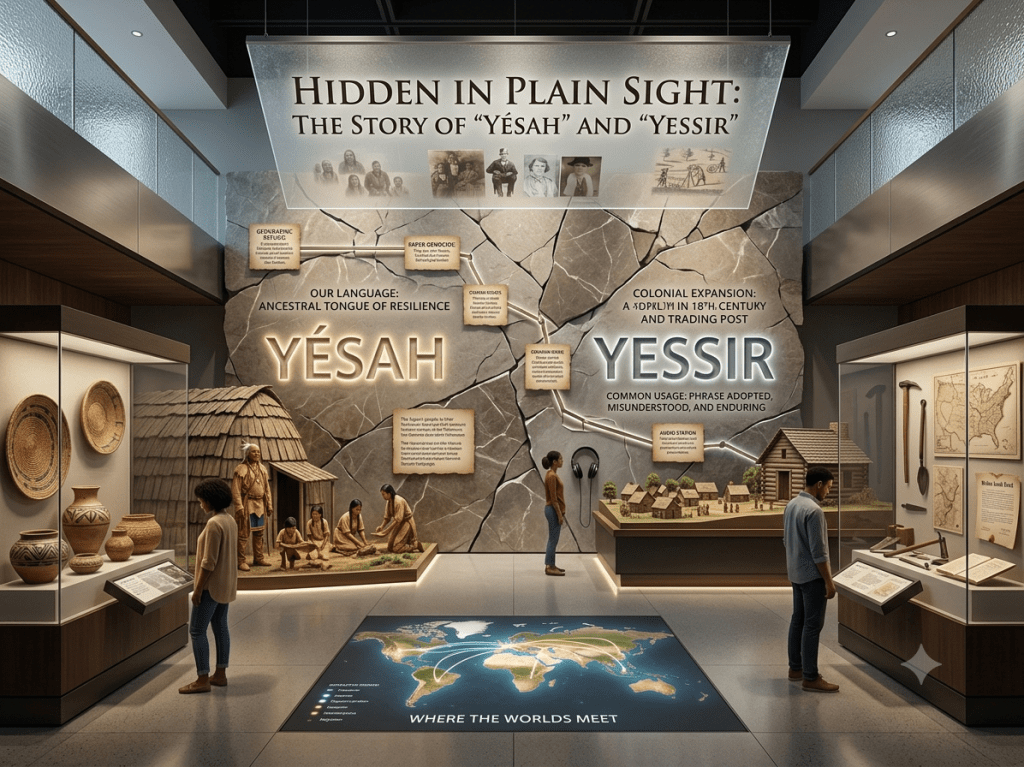
Hidden in Plain Sight: The Story of “Yésah” and “Yessir”
In the history of the American South, survival often required a brilliant form of camouflage. For the ancestors of the Haliwa-Saponi, Occaneechi, and Tutelo peoples who took refuge along Shocco Creek and the lowlands of the Warren County Meadows, protecting their identity meant learning to speak in double meanings.
There is no greater example of this than the deep, hidden connection between the ancestral word Yésah and the Southern expression “yessir.”
Two Words, Two Worlds
In the traditional Eastern Siouan language (Yesá:sahį́), the native word for the tribe is Yésah (often pronounced Yee-sah or Yee-shą́). It does not mean a political boundary or a legal definition on a piece of paper; it translates simply and profoundly to “The People” or “The Human Beings.” It was a badge of absolute sovereignty and ancestral pride.
As the 1800s arrived and the strict racial laws of the pre-Civil War and Jim Crow eras took hold, speaking a Native American language in public became incredibly dangerous. Openly identifying as an Indian could lead to a family’s land being stripped away, physical violence, or legal arrest by county officials who were determined to enforce a strict black-and-white binary.
To survive, the families of the Shocco community had to hide their language in plain sight.
The Power of Linguistic Camouflage
Because the English contraction for “Yes, sir” slurs heavily in rural Southern dialects into “Yessah” or “Yessuh,” your ancestors discovered a phonetic shield.
When a tribal elder or a child used the sacred word Yésah to identify themselves or their community, to the untrained ear of a white planter or a county sheriff, it sounded exactly like a polite, submissive Southern drawl saying “Yessir.”
This created a powerful double meaning that allowed the community to declare their humanity right in front of the people oppressing them:
To the white outsider, the word sounded like compliance: “Yes, sir.”
To the tribal community, the word whispered resistance: “We are the human beings. We are The People.”
An Unbroken Vibration
This practice is what historians and linguists call linguistic camouflage. When a dominant culture tries to violently stamp out a language, the surviving group will subconsciously map their old, sacred sounds onto the vocabulary of the new language. By leaning heavily into the Southern custom of saying “yessir,” the ancestors kept the physical mouth-movements, the cadence, and the spiritual vibration of Yésah alive without drawing dangerous attention to their roots.
When we look back at the way our grandmothers and elders spoke in Warren County, we aren’t just hearing a rural accent. We are hearing the unbroken echo of an ancient language that refused to be erased.
We were blocked from a TikTok conversation, trying to build a relationship of understanding , because this diaspora African is more interested in a title than an outcome! Tittles of power only produce problems and responsibilities , but when you build trusted relationships that span multiple people, you create solid outcomes! Africans and Caribbean folk pride is about entitlement more than good outcomes! that’s why they flee their countries looking for a tittle instead of building their country! She’s African, would like to look like an indigenous American, but her attitude and ways of living speak differently . She does not possess good relationships building skills , and is a threat to Americans values!